PRODUCT DESIGN•6 min read•Aug 18, 2026

Should You Redesign Your Product or Start With a UX Audit?

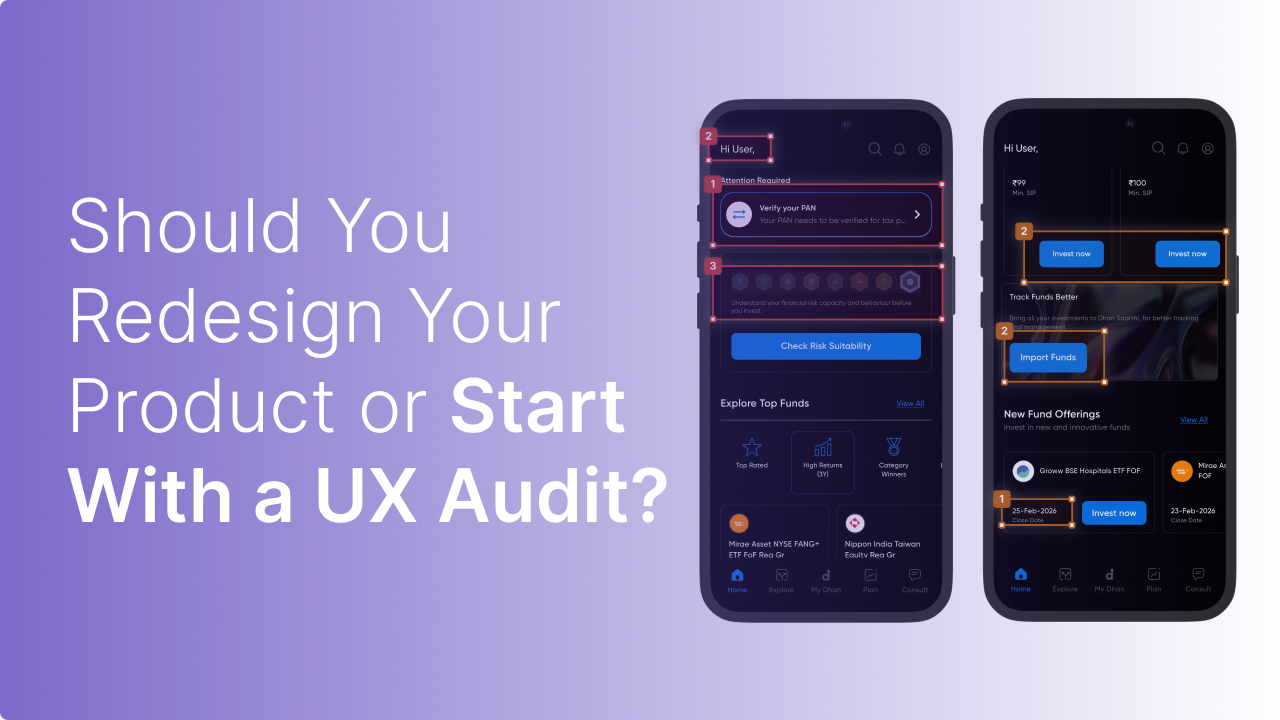
Before committing to a complete product redesign, explore whether your digital product needs a new interface or simply a better user experience through a UX audit.
Sarah Connor
Sarah ConnorSenior Product Designer, Juxify
Share this article
Should You Redesign Your Product or Start With a UX Audit?

Should You Redesign Your Product or Start With a UX Audit?

Your product is live, users are visiting, and your team has invested time and resources into building the experience. But something isn't working as expected.
Maybe users are abandoning the onboarding process. Perhaps your conversion rates are declining, or customers are struggling to find important features. Your first instinct might be to redesign the entire product.
But is a complete redesign really necessary?
Many businesses invest in product redesigns without fully understanding the problems affecting their user experience. While a redesign can improve usability and modernize a product, it can also introduce unnecessary costs, development delays, and new usability challenges.
That's where a UX audit becomes valuable.
Before committing to a complete redesign, it's worth understanding whether your product needs a new interface or simply a better experience.
In this guide, we'll explore the differences between a UX audit and a product redesign, when each approach makes sense, and how to choose the right solution for your digital product.

What Is a UX Audit?

A UX audit is a structured evaluation of a digital product's user experience. Its purpose is to identify usability issues, friction points, and opportunities to improve how people interact with your product.
Instead of changing the entire design, a UX audit focuses on understanding what's working, what's creating difficulties, and why users may be struggling to complete important actions.
A comprehensive UX audit may include:
  • Usability evaluation: Identifying navigation problems, confusing interactions, and unnecessary steps in user journeys.
  • User behavior analysis: Reviewing analytics, session recordings, and user flows to understand where users encounter friction.
  • Heuristic evaluation: Assessing the interface against established usability principles and design best practices.
  • Conversion journey analysis: Examining signup flows, onboarding experiences, checkout processes, and other important user actions.
  • Accessibility review: Identifying potential barriers that make the product difficult to use for people with different needs.
  • Actionable recommendations: Prioritizing improvements based on their potential impact, severity, and implementation effort.
The outcome is typically a clear picture of your product's usability challenges, supported by findings and recommendations.
A UX audit doesn't necessarily mean your product needs a redesign. In many cases, it reveals smaller improvements that can make a meaningful difference.

What Is a Product Redesign?

A product redesign involves making significant changes to an existing digital product's interface, experience, structure, or functionality.
Depending on the project's scope, a redesign may involve updating visual elements, reorganizing navigation, improving user journeys, or rebuilding major sections of the product.
For example, a SaaS platform may have expanded its features over several years without updating its information architecture. As a result, users may struggle to navigate the dashboard or discover important functionality.
In this situation, a product redesign could help simplify the experience and create a more scalable structure.
However, redesigning a product is more than changing colors, typography, or layouts.
An effective redesign should address real user problems while supporting business goals. It often requires user research, UX strategy, interface design, prototyping, usability testing, and collaboration with development teams.
Without sufficient research, even a visually impressive redesign can fail to improve the actual user experience.

Five Signs Your Product Needs a UX Audit

Not every usability problem requires a complete redesign. Sometimes, the biggest improvements come from identifying and fixing specific issues.
Here are five situations where starting with a UX audit makes sense.

1. Users Are Visiting but Not Converting

Your product might attract visitors, but relatively few are signing up, requesting demos, or completing purchases.
The problem isn't necessarily the visual design.
Users might be encountering confusing forms, unclear calls to action, complicated navigation, or unnecessary steps.
A UX audit can help identify where users are dropping off and investigate potential reasons behind their behavior.
Rather than redesigning every page, your team can focus on the areas that create the greatest friction.

2. Your SaaS Product Has a High Onboarding Drop-Off Rate

For SaaS businesses, onboarding plays an important role in helping new users understand the product's value.
If users abandon the setup process before completing important actions, there may be problems with the onboarding experience.
For example, users might encounter too many form fields, unclear instructions, or features introduced before they're relevant.
A SaaS UX audit can examine the onboarding journey and highlight opportunities to simplify it.
Improving these early interactions may help more users reach their first meaningful product outcome.

3. Customers Frequently Report Usability Problems

Are customers repeatedly asking how to find features, complete tasks, or navigate the interface?
Frequent usability-related support requests can indicate that parts of your product aren't as intuitive as they should be.
A UX audit helps organize these concerns into specific usability findings.
By combining customer feedback with behavioral data and interface evaluation, teams can identify recurring issues rather than relying on individual complaints.

4. Your Product Has Added Features Over Time

Digital products naturally evolve.
As new features are introduced, navigation menus become larger, dashboards become more complex, and workflows can become harder to follow.
This is particularly common in growing SaaS products.
A UX audit can evaluate whether the existing information architecture still supports users' needs.
Sometimes, reorganizing navigation or improving feature discoverability is enough. Other times, the findings may indicate that a broader redesign is necessary.

5. You're Unsure What's Causing Poor Product Performance

Perhaps your product has a high bounce rate, low feature adoption, or declining engagement.
These metrics can indicate potential problems, but they don't explain the underlying causes.
A UX audit brings together available evidence to investigate what may be happening.
This gives your team a more informed starting point before investing in major design changes.

When Does Your Product Actually Need a Redesign?

While UX audits are useful for diagnosing problems, there are situations where a product redesign may be the more appropriate long-term solution.

Your Product No Longer Supports User Needs

A product designed for a small group of early adopters may struggle to meet the expectations of a much larger audience.
As your business grows, your users, workflows, and product requirements may change.
If the existing experience can no longer support those needs effectively, a redesign may be necessary.

The Information Architecture Is Fundamentally Broken

When navigation problems exist throughout the product, individual fixes may not solve the underlying issue.
For example, if user experience consistently struggle to understand how different features relate to one another, the product may need a new information architecture.
This can require changes to navigation, page hierarchy, content organization, and interaction patterns.

Your Product Has Significant Accessibility Issues

If accessibility barriers are widespread across the interface, fixing isolated components may not be sufficient.
A broader redesign may help establish accessible patterns, reusable components, and consistent interaction standards.
However, accessibility improvements shouldn't automatically wait for a full redesign. Critical barriers should be addressed as early as possible.

Your Business Model or Product Strategy Has Changed

A product originally designed for individual consumers may later shift toward enterprise customers.
These audiences often have different expectations, workflows, and requirements.
When the product strategy changes significantly, the existing experience may need to evolve alongside it.
A redesign can help align the interface with the product's new direction.

Your Existing Design System Cannot Scale

Inconsistent components, outdated interaction patterns, and fragmented design decisions can make it difficult to introduce new features efficiently.
If the design system has become difficult to maintain, a more comprehensive redesign may create a stronger foundation for future development.

Why You Should Consider a UX Audit Before Redesigning

A complete product redesign can require a significant investment of time, budget, and development resources.
Starting with a UX audit can help teams make that investment more strategically.

Understand the Actual Problems

Without research, redesign decisions can become subjective.
Stakeholders may focus on visual preferences while overlooking the usability issues affecting users.
A UX audit shifts the discussion toward evidence.
It helps teams understand which parts of the experience are creating friction and which are already working well.

Avoid Unnecessary Design Changes

Not every part of your product needs improvement.
Some existing features may already support users effectively.
Redesigning these areas without a clear reason can introduce new problems or disrupt familiar workflows.
An audit helps distinguish between experiences that need improvement and those worth preserving.

Prioritize High-Impact Improvements

A UX audit can help categorize usability issues by severity, potential business impact, and implementation effort.
This allows teams to address important problems first.
For example, simplifying a confusing signup form may be a more practical starting point than redesigning an entire dashboard.

Make Better Use of Your Budget

A UX audit requires an upfront investment, but it can reduce the risk of spending resources on changes that don't address the underlying problems.
It can also help define a more focused redesign scope.
Instead of rebuilding everything, teams can concentrate on the journeys and components that genuinely need attention.

Build a More Effective Redesign Strategy

If a redesign is necessary, the audit findings can inform its direction.
They can help establish design priorities, identify important user journeys, and define measurable objectives.
This creates a stronger foundation for design decisions and subsequent usability testing.

How Juxify Helps Businesses Make Better UX Decisions

At Juxify, we believe effective digital product design starts with understanding the problem before designing the solution.
For SaaS businesses, startups, and growing digital products, design decisions should support both user needs and business objectives.
Whether you're evaluating an existing product experience or considering a larger redesign, a research-led approach helps bring clarity to the process.
A UX audit can help identify usability challenges, uncover friction in important user journeys, and establish priorities for improvement.
When a product requires more substantial changes, these insights can inform a redesign strategy focused on usability, consistency, and long-term product growth.
Rather than redesigning simply to create a different visual experience, the objective should be to make the product easier to understand, navigate, and use.

Final Thoughts: Audit First or Redesign?

A product redesign isn't always the answer to poor user experience.
If your product has conversion challenges, onboarding friction, or usability complaints, a UX audit can help uncover the underlying problems before you commit to major changes.
On the other hand, if your product's structure no longer supports your users or business goals, a redesign may be necessary.
The most effective approach is often to audit first and redesign where the evidence shows it's needed.
By understanding your product's strengths and weaknesses, you can make more confident design decisions, prioritize meaningful improvements, and avoid unnecessary changes.
Sarah Connor

Jay Williams

Senior Product Designer

Jay Williams is a Senior Product Designer focused on creating intuitive digital products, scalable design systems and meaningful user experiences. When he's not wireframing complex SaaS structures, he's actively mentoring designers.

You might also like

Fresh perspectives and practical frameworks from the design frontlines.
Should You Redesign Your Product or Start With a UX Audit?
PRODUCT DESIGN

Should You Redesign Your Product or Start With a UX Audit?

Before committing to a complete product redesign, explore whether your digital product needs a new interface or simply a better user experience through a UX audit.

Sarah Connor
Sarah Connor
Aug 18, 2026•6 min read
AI Product Design: What Is It and How Does It Work?
AI & PRODUCT DESIGN

AI Product Design: What Is It and How Does It Work?

Explore what AI product design means, how it works, the step-by-step process of designing AI-powered products, and key principles for success.


Jay Williams
Jay Williams
Oct 15, 2026•10 min read
Building a Scalable Design System Without Slowing Down
DESIGN SYSTEMS

Building a Scalable Design System Without Slowing Down

Learn how to strike the perfect balance between strict component consistency and immediate design velocity.

Elena Rostova
Elena Rostova
Aug 10, 2026•5 min read

Let's design something meaningful.

Have a complex product challenge? Our team can help turn your ideas into intuitive, scalable digital experiences that users love.

View All Projects

PROJECT DISCUSSION STRENGTH:

Discuss your project directly with us and get expert guidance

Share your business idea, project details, and requirements in a 1-hour discovery call. We'll help you understand the best approach, estimated cost, and timeline. Whether you're starting fresh or improving an existing project, we'll make sure it's a perfect fit for your goals.

Client 1Client 2Client 3

Trusted by multiple happy clients worldwide

Jay Williams

Jay Williams

Design Director

1 Hour Strategy Session
Google Meet details sent on confirmation.
🌐Timezone: Auto-Detect (Your Local)

Select a Date & Time

October 2026

Mo
Tu
We
Th
Fr
Sa
Su