A product can look beautiful and still fail.
It can have polished interfaces, thoughtful animations, a sophisticated design system, and hundreds of carefully designed screens. Yet if users cannot understand what to do, businesses may struggle to get the results they expected.
The problem is rarely just the interface.
The real impact often comes from the product decisions behind it.
Product design is the process of turning a problem into a product that people can understand, use, and value. It brings together research, strategy, user experience, interface design, technology, and continuous learning to create products that work for both people and businesses.
Whether you're building a SaaS platform, AI product, mobile application, dashboard, or enterprise software, the principles remain similar.
Before designing the solution, understand the problem.
Before designing the experience, understand the people.
And you need to keep learning after the product goes live.
This guide explores how that process works and why good product design is about much more than creating attractive screens.
What Is Product Design?
Product design is the process of defining, designing, testing, and improving a product around real user needs and business objectives.
For digital products, that can involve everything from early product discovery and research to user flows, wireframes, prototypes, UI design, design systems, usability testing, and product redesign.
But listing activities does not really explain what product design is.
At its core, product design is about making better decisions under uncertainty.
Imagine a SaaS company discovers that new customers are abandoning its onboarding process.
The first instinct might be to redesign the onboarding screens.
But what if the real problem is not the interface?
Research might reveal that users are being asked for information they do not have. Or that they are presented with too many configuration decisions before experiencing any value. Or perhaps the product is trying to explain every feature instead of helping users achieve their first meaningful outcome.
The visual redesign might eventually be part of the solution.
But the most important product decisions were made before that.
The team had to understand why the problem existed.
That is what separates product design from simply designing interfaces.
Why Product Design Matters?
Digital products are becoming more capable and more complex at the same time.
A modern product might include automation, analytics, collaboration, payments, integrations, personalised experiences, or AI-powered functionality. Each additional capability creates another decision for the user to understand.
The challenge is not always reducing functionality.
It is reducing unnecessary cognitive effort.
When users don't understand a product, they don't see the complexity behind it. They simply feel the friction.
They hesitate.
They make mistakes.
They abandon tasks.
Or they leave.
Large-scale UX research demonstrates how these seemingly small usability problems can have measurable commercial consequences. Baymard's research, based on extensive testing of ecommerce experiences, has repeatedly found significant opportunities to improve conversion by addressing usability problems in the customer journey.
The principle applies far beyond ecommerce.
A complicated onboarding experience can affect activation. A confusing workflow can affect productivity. Poor navigation can hide valuable functionality. An unclear interface can reduce trust.
Good product design helps make the complexity behind a product feel simpler to the person using it.
Product Design vs UX and UI Design
Product design, UX design, and UI design overlap, but they are not interchangeable.
UI design focuses on the interface itself: visual hierarchy, typography, colour, spacing, components, states, and interaction details.
UX design focuses more broadly on the experience: how information is organised, how users move through the product, what they need at each stage, and where friction occurs.
Product design takes a wider perspective.
It considers the relationship between the user, the business, the product, and the technology.
A product designer may conduct research, define user flows, create wireframes, build prototypes, design interfaces, test concepts, and contribute to product strategy.
The difference is therefore less about job titles and more about scope.
UX and UI can be part of product design.
Product design simply starts asking questions earlier and continues asking them after the interface is finished.
The Product Design Process
There is no single product design process that every company should follow.
A startup validating its first product should not work in exactly the same way as an enterprise redesigning a mature platform.
But effective product teams generally move through a similar cycle:
Understand → Define → Explore → Design → Validate → Improve
The stages overlap.
Research can change the strategy. Testing can expose a problem in the user flow. Technical constraints can change an interaction. Data from a live product can challenge assumptions made during discovery.
That's not a problem with the process.
The purpose of product design is not to predict everything perfectly from the beginning. It is to reduce uncertainty as the product develops.
Start With the Problem
One of the biggest mistakes in product development is jumping straight to the solution.
A stakeholder requests a feature.
A competitor launches something new.
A customer asks for an improvement.
Someone says, "We need a dashboard."
And the design process begins.
But before deciding what to build, teams need to understand what problem they are actually trying to solve.
Who experiences it?
How often does it happen?
What are users doing today?
What makes the existing experience difficult?
What would a successful outcome look like?
And perhaps the most important question:
Is this a problem worth solving?
This is where product discovery comes in.
Discovery gives teams an opportunity to investigate the problem before becoming committed to a particular solution.
It can reveal opportunities that would otherwise remain hidden behind an initial feature request.
Research Turns Assumptions Into Evidence
Every product team has assumptions.
The danger is when assumptions quietly become requirements.
"We think users want this."
"They'll understand what this button does."
"They probably know where to find the feature."
"Customers will figure it out."
Research gives those assumptions something to be tested against.
User interviews, usability testing, surveys, behavioural analytics, customer feedback, support conversations, and competitor research can all contribute to a better understanding of the people using a product.
But research should not become a documentation exercise.
A research report sitting in a folder does not improve a product.
The value of research is in the decisions it changes.
A research session might reveal that users do not need another feature. They need a clearer workflow.
It might show that customers are not ignoring a feature. They simply cannot find it.
It might reveal that two user groups have completely different expectations from the same product.
These insights can change the product strategy before expensive development begins.
Strategy Decides What Matters
Research can tell you what users are experiencing.
Product strategy helps determine what to do about it.
A product rarely has the resources to solve every problem at once. There are always more potential features, improvements, and opportunities than the team can realistically pursue.
Strategy creates focus.
It connects user needs with business objectives and technical realities.
Instead of asking only, "What could we build?", the team starts asking:
"What should we build first, and why?"
That distinction matters.
A product with fewer, better-prioritised capabilities can often create a clearer experience than one overloaded with functionality.
Good product strategy is therefore partly about knowing what not to build.
User Flows Are Product Decisions
Before someone sees a polished interface, they experience a sequence of decisions.
They choose where to go.
They provide information.
They encounter options.
They confirm actions.
They make mistakes.
They recover from those mistakes.
A user flow maps this journey.
But a user flow is more than a diagram with arrows between screens.
Every step represents a product decision.
If a banking application requires six steps to complete a simple transfer, that is a product decision.
If an important SaaS feature is buried three levels deep, that is a product decision.
If an AI application requires users to understand complex prompting before they can get value, that is a product decision.
Mapping these journeys early gives teams a chance to challenge those decisions before they become expensive to change.
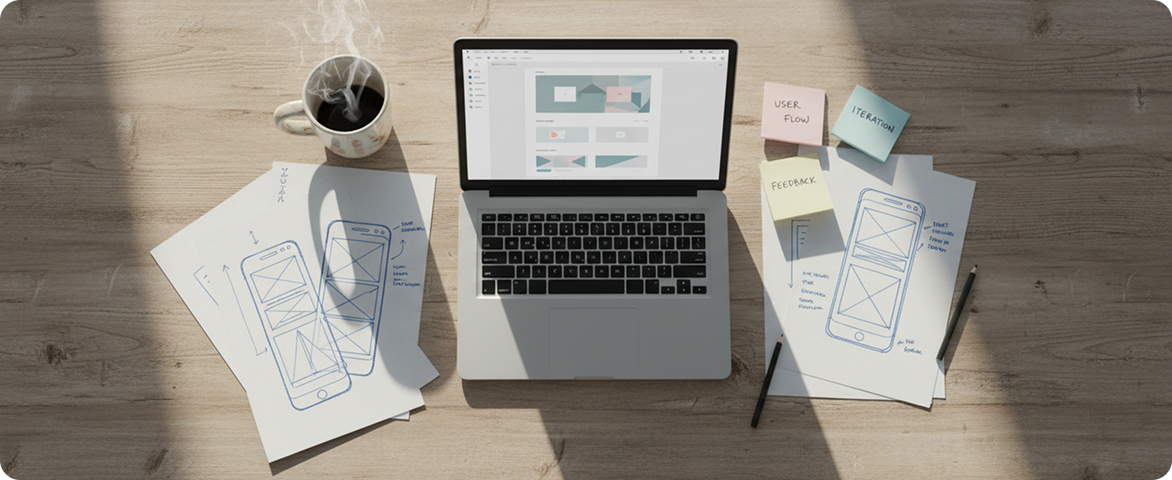
Wireframes Make Change Cheaper
Once the problem, users, and core flows are clearer, designers can begin exploring the interface.
This is where wireframes become valuable.
Wireframes deliberately remove much of the visual polish so teams can focus on structure.
Where should important information appear?
What needs to happen first?
What can be removed?
What happens when there is no data?
What happens when something goes wrong?
What does the user need to know before taking the next action?
These questions are easier to explore before typography, colour, imagery, and visual details enter the conversation.
The real value of wireframing is not the wireframe itself.
It is the ability to explore and change ideas while change is still inexpensive.
Prototypes Turn Ideas Into Experiences
A static screen can show you what a product looks like.
A prototype can show you how it behaves.
That difference is important.
A clickable prototype allows designers, stakeholders, developers, and potential users to experience a proposed workflow before it is built.
A prototype might reveal that an interaction is confusing, that a transition is missing, or that users do not understand what happens after completing an action.
It creates something concrete to react to.
Instead of discussing what the product might feel like, people can interact with an early version of it.
That makes prototyping one of the most useful ways to identify problems before they become code.
UI Design Should Make Complexity Understandable
Once the product structure is working, visual design brings the experience together.
This is where UI design becomes critical.
Typography establishes hierarchy.
Spacing separates ideas.
Colour communicates meaning.
Components create consistency.
States explain what has happened.
Motion can communicate change.
But good UI is not decoration placed on top of a product.
It is a communication system.
A user should be able to look at an interface and understand where they are, what matters, what they can do, and what will happen next.
A visually impressive interface that makes those things harder to understand is not good product design.
The best interfaces use visual design to make useful behaviour easier to understand.
Design Systems Turn Good Decisions Into a Foundation
Designing one screen is relatively straightforward.
Maintaining consistency across hundreds of screens is much harder.
As a product grows, teams repeatedly solve similar problems: buttons, forms, navigation, tables, notifications, empty states, error messages, typography, spacing, and interaction patterns.
A design system creates a shared foundation for those decisions.
But a design system is more than a collection of reusable components.
It creates a common language between design and development.
It allows teams to build faster without repeatedly reinventing basic patterns. More importantly, it gives designers more time to focus on the problems that actually require new thinking.
For SaaS and enterprise products in particular, this becomes increasingly important as features, teams, and user journeys grow.
Testing Brings Design Back to Reality
A design team can make a well-informed decision and still be wrong.
That is not unusual.
People do not always behave the way teams expect.
A prototype may seem obvious internally but confuse users.
Analytics may reveal that a supposedly important feature is rarely used.
Customer feedback may expose a problem nobody on the team noticed.
Testing creates an opportunity to discover these gaps.
Usability testing, prototype testing, analytics, interviews, A/B testing, and other forms of validation can help teams understand whether the experience works outside the design room.
The important part is what happens next.
Testing should lead to learning.
Learning should lead to decisions.
And decisions should lead to improvement.
Design → Test → Learn → Improve.
That cycle is what makes product design an ongoing discipline rather than a one-time project.
Product Design Does Not End at Launch
Launch day is often treated as the finish line.
For a product team, it is better understood as the beginning of another learning cycle.
Once a product is live, real behaviour starts generating new evidence.
You can see where users abandon a workflow, which features become valuable, which areas create support requests, and where people continue to struggle.
This information creates a feedback loop between the product and the people using it.
The product generates evidence.
The evidence creates new questions.
The questions create new product decisions.
Those decisions create new opportunities for design.
This is why strong digital product design continues after development and launch.
Product Redesign: When a Product Outgrows Its Experience
Products change over time.
A feature becomes five features.
A simple navigation structure becomes complicated.
A small customer base becomes a large one.
New business requirements appear.
New technologies are introduced.
The product accumulates years of decisions.
Eventually, an experience that once felt simple can become difficult to navigate.
That is when product redesign becomes valuable.
But redesign should not start with:
"Let's make it look modern."
It should start with:
"What is no longer working?"
Sometimes the problem is visual.
Often, it is structural.
The information architecture may no longer match how users think. Important workflows may contain unnecessary steps. New functionality may have been added without reconsidering the overall experience.
A strong redesign preserves what works while challenging what does not.
Designing Better SaaS Products
SaaS products often hide significant complexity behind a relatively simple interface.
Users might manage teams, permissions, billing, integrations, reports, workflows, automation, and data from the same platform.
The goal of SaaS product design is not to pretend that this complexity does not exist.
It is to organise that complexity so people can work with it confidently.
Onboarding should help users reach value quickly.
Navigation should reflect how people actually work.
Dashboards should prioritise useful information rather than simply displaying everything available.
Empty states should explain what happens next.
Errors should explain what went wrong and how to recover.
And as the product grows, the design system should keep the experience coherent.
Good SaaS product design does not remove complexity from the product.
It removes unnecessary complexity from the user's experience.
Designing AI Products Is a Different Challenge
AI is changing what a digital product can do.
It is also changing what users need from the interface.
Traditional software often works around predictable inputs and outputs.
AI can behave differently.
The same request can produce different results. An answer can be useful in one context and wrong in another. Users may not know what the system can do, why it produced a particular result, or when they should trust it.
That makes AI product design fundamentally different from simply adding an AI feature to an existing interface.
The product needs to communicate capability and limitations.
It needs to give users ways to provide feedback and correct results.
It needs to make important decisions understandable.
And where appropriate, it needs to keep people in control.
Research into AI-powered interfaces increasingly points to transparency, feedback, and appropriate levels of trust as important parts of the user experience design. The challenge is not simply making users trust AI. It is helping them understand when they should and should not rely on it.
That makes AI interaction design a product problem, not just a UI problem.
What Good Product Design Looks Like
Good product design is often difficult to notice.
When it works, users do not think about the design.
They simply know what to do.
The navigation feels natural.
The next step feels obvious.
The interface gives them the right information at the right moment.
Errors are understandable and recoverable.
Complex tasks feel manageable.
The product behaves consistently.
And when something is unfamiliar, the experience helps users understand it without forcing them to read a manual.
That is the real measure of product design.
Not the number of screens.
Not the number of components.
Not how impressive the prototype looks.
How effectively does the product help someone accomplish something that matters?
How Product Design Creates Business Value
Design is sometimes treated as a purely visual discipline.
But product design can influence much more than appearance.
A clearer onboarding experience can influence activation.
A simpler workflow can reduce friction.
Better information architecture can make valuable features easier to discover.
A more understandable checkout can reduce abandonment.
A well-designed SaaS experience can make complex tasks easier to complete.
These outcomes are not guaranteed simply because a product has been redesigned.
That is why measurement matters.
Good product teams connect design decisions with meaningful outcomes and use evidence to understand whether those decisions worked.
UX research organisations such as Nielsen Norman Group have long advocated connecting UX metrics with business objectives rather than treating usability as an isolated design concern.
The goal is not to claim that every design change will produce a predictable percentage increase in revenue.
The goal is to understand whether the product is becoming more useful, usable, and valuable.
Design is an investment in better product decisions.
Product Design Services
Different products need different kinds of design support.
An early-stage startup may need help turning an idea into something that can be validated.
An established SaaS company may need to simplify a complex workflow.
An enterprise team may need a design system capable of supporting multiple products.
An AI company may need to rethink how people interact with intelligent functionality.
This is why effective product design services should adapt to the product rather than force every project through the same process.
Depending on the challenge, product design can span discovery, research, strategy, UX, UI design, prototyping, testing, design systems, redesign, and ongoing product improvement.
The deliverables may change from project to project.
The objective remains the same:
Make better product decisions and turn them into experiences people can use.
What to Look for in a Product Design Agency
Choosing a product design agency should involve more than looking at a portfolio.
A portfolio can show you what a team produced.
It does not always show you how the team thinks.
Ask how they approach problems before designing solutions.
Do they investigate user needs?
Can they connect design decisions to business objectives?
Do they challenge assumptions?
Can they simplify complex products?
Do they validate their thinking?
Can they collaborate effectively with developers?
And can they work as part of your product team rather than simply receiving a brief and returning a collection of screens?
The right agency should feel less like an outsourced design resource and more like a design partner.
How Juxify Approaches Product Design
At Juxify, we see product design as a continuous process of understanding, deciding, designing, and learning.
We do not believe every project should start with the same template.
The right approach depends on the product, the users, the business objectives, and where the product is in its journey.
Sometimes the biggest opportunity is hidden inside an existing workflow.
Sometimes it is an early product idea that needs validation.
Sometimes a successful product has simply become too complicated as it has grown.
And sometimes the challenge is entirely new, such as designing an AI-powered product where users need to understand not only what the system can do, but when they should rely on it.
Our role is to turn those challenges into clearer product decisions and better digital experiences.
From discovery and strategy through UX, UI, prototyping, design systems, and validation, we work with teams to design digital products around the people who use them and the businesses that depend on them.
Frequently Asked Questions
What is product design?
Product design is the process of defining, designing, testing, and improving a product around user needs, business objectives, and technical realities. For digital products, it can span discovery, research, strategy, UX, UI, prototyping, testing, and design systems.
What is the difference between product design and UX/UI design?
UX and UI are important parts of product design, but product design has a broader scope. It considers not only how a product looks and works, but also what should be built, why it matters, who it serves, and how it creates value.
What does the product design process involve?
A typical product design process moves from understanding the problem through research and strategy into user flows, wireframes, prototypes, UI design, testing, and iteration. The process is not always linear because new evidence can change earlier decisions.
How long does digital product design take?
There is no fixed timeline. A focused feature may take several weeks, while a complex SaaS platform or new digital product can require several months. The timeline depends on scope, complexity, research requirements, platforms, and the amount of validation needed.
How much do product design services cost?
Product design costs depend on the product, scope, complexity, research requirements, number of workflows, platforms, and level of involvement. A clearly defined project scope makes it easier to provide an accurate estimate.
Can product design improve an existing product?
Yes. Product design can be used to identify usability problems, simplify workflows, restructure information architecture, improve interfaces, introduce new functionality, and create a more scalable foundation for an existing product.
Does product design include UX research?
It can, and research is often an important part of the process. UX research helps teams understand user behaviour, identify problems, challenge assumptions, and make more informed product decisions.
Does product design include UI design?
Yes. UI design is an important part of digital product design, but it is only one part of the overall process. Product design also considers research, strategy, UX, interactions, validation, business objectives, and technical realities.
Does Juxify develop digital products?
Juxify has a development team and can support development depending on the client's requirements. The level of development involvement is determined by the project's scope and the client's needs.

You might also like
Fresh perspectives and practical frameworks from the design frontlines.
Designing SaaS Products That Users Actually Enjoy
How we applied emotional design principles to turn boring enterprise screens into an experience that boosts customer retention.

Why UX Research Should Start Before the First Wireframe
Stop designing based on assumptions. Explore the exact user research methodologies that validate product-market fit early.

Building a Scalable Design System Without Slowing Down
Learn how to strike the perfect balance between strict component consistency and immediate design velocity.

Let's design something meaningful.
Have a complex product challenge? Our team can help turn your ideas into intuitive, scalable digital experiences that users love.
PROJECT DISCUSSION STRENGTH:
Discuss your project directly with us and get expert guidance
Share your business idea, project details, and requirements in a 1-hour discovery call. We'll help you understand the best approach, estimated cost, and timeline. Whether you're starting fresh or improving an existing project, we'll make sure it's a perfect fit for your goals.


Trusted by multiple happy clients worldwide

Jay Williams
Design Director